
Reading Strategies
Reading Foundations
Before we dive into specific reading methods, there are some foundations for reading you should consider:
- Pace yourself: Read in 30-50 minute segments at most.
- Look for big ideas first, then key supporting details. Do not try to grasp and retain everything at once.
- Make connections between what you are reading, your own knowledge, and other texts you have been researching.
- Try visualizing concepts concretely. You may even draw diagrams or webs to depict associations.
- Try reading aloud with a friend or use the text-to-speech function on electronic documents. This is especially helpful if you are an auditory (listening) learner.
- Try outlining the text by summarizing the main idea of each paragraph in a few words.

The SQ4R Method
SQ4R is a strategy for reading and retaining information that has been proven to help students better understand and retain information. This method includes six steps: Survey, Question, Read, Record, Recite, and Review.
Survey
This step is pre-reading, grasping the big picture of what the text is about. Skim through the pages for any information that stands out. Some things to look out for include:
- Read the summary (sometimes called an abstract) of the chapter or article. This should give you a general sense of the text’s argument.
- Preview any headings, bolded, or italicized words, and illustrations. These are great signposts for key information.
- If there are questions at the end of the text, read them before reading the chapter or article in full. Knowing the questions before you read will help you recognize the text’s key ideas when they come up.
- Quickly glance through the rest of the text, looking for any other words or ideas that stand out.
Question
Before you start your proper read-through, ask questions about the text based on your skim and your own thoughts.
- Include those questions at the top of your notes/in the margins of the chapter or article.
- Your questions should have to do with the argument(s) of the text as well as anything relevant to your class/assignments.
- Look for answers to your questions as you read. Feel free to add more questions when they come up.
Read
Or more importantly, read actively.
- Carefully read the text’s introduction. Identify the author’s thesis statement and then look for how the author fleshes out their argument in the text.
- Use your senses to imagine what you are reading about.
- Look up unfamiliar concepts to improve your understanding of the text.
- Consider why you are reading this text.
- If it is a reading for class, consider the key themes and ideas of that week’s lecture.
- If it is for a research paper, keep in mind the ideas you are trying to prove in your argument.
Record
Write down notes or create flashcards to keep track of your ideas. This is especially useful if you are a kinesthetic (hands-on/movement-based) learner.
Recite
Don't just stop with reading. Go back and speak aloud the main points of the argument, either to yourself or a friend.
Review
Within 24 hours, go back over the notes you took and the ideas you discovered.
- This is more important for in-class readings, but it can also be useful for retaining information long-term when working on a paper.
Annotation
In the Read and Record phases, it can sometimes be useful to annotate the text you are reading. Consider the following techniques:
- Underline the main points. Put stars beside the most crucial ones.
- Circle keywords.
- Draw arrows between related concepts.
- Jot down questions and summarize ideas in the margins.
- Use numbers to make a sequence of ideas.
- If you are going to use highlighters, it is best to use multiple colours, with each colour matching a different main idea. This way, you can easily follow the argument later.
*NOTE: Only do these annotations with a source you own or have downloaded for yourself. For a library book, consider sticky notes or folding the page corner to identify important information.
Annotation Example
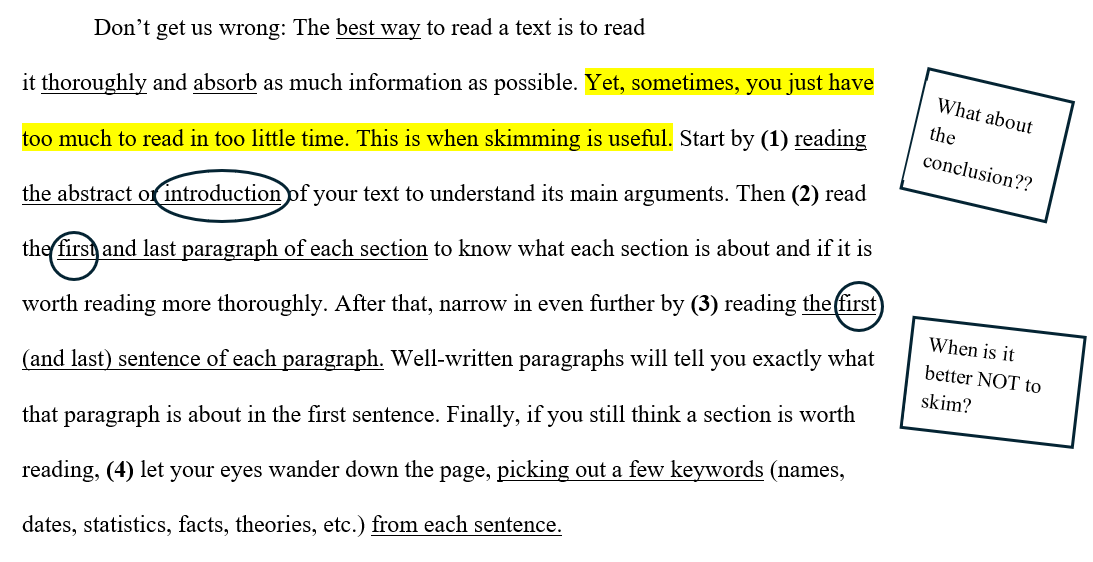
Let’s look at an example! The following paragraph uses the annotation suggestions above to identify important information. Just remember that different people will find different information important.
Alternative Text Example:
Don’t get us wrong: The best way to read a text is to read it thoroughly and absorb as much information as possible. Yet, sometimes, you just have too much to read in too little time. This is when skimming is useful. Start by (1) reading the abstract or introduction of your text to understand its main arguments. Then (2) read the first and last paragraph of each section to know what each section is about and if it is worth reading more thoroughly. After that, narrow in even further by (3) reading the first (and last) sentence of each paragraph. Well-written paragraphs will tell you exactly what that paragraph is about in the first sentence. Finally, if you still think a section is worth reading, (4) let your eyes wander down the page, picking out a few keywords (names, dates, statistics, facts, theories, etc.) from each sentence.
Question: What about the conclusion?
Question: When is it better NOT to skim?

